
Memory in Transformation — Bodies and Posthuman Imaginaries

Memory in Transformation — Bodies and Posthuman Imaginaries, a group exhibition featuring artists from China and the United States, opens on September 18, 2026, at the Research House for Asian Art in Chicago.
Exploring the body, memory, artificial intelligence, robotics, and the emerging posthuman condition, the exhibition brings together 18 artists from Chicago, New York, Los Angeles, Chengdu, Shenzhen, and other cities. Works span video, digital art, painting, installation, and performance. The opening reception will take place on Friday, September 18, from 6 to 9 p.m.
The works approach these questions from different directions. Some directly explore the relationship between artificial intelligence, digital technology, and the body; others begin with personal memories, bodily gestures, and everyday perception to consider how experience is recorded, shaped, and changed. In some works, memory appears as fragments of life, bodily traces, or ancient symbols, reorganized through painting, materials, and technology. Transformation thus extends beyond changes in appearance to the process through which people and the world around them shape one another: people express themselves through technologies and objects, which in turn help transform their perceptions, habits, and imaginations.
According to Kira Wu, Exhibition Director and Curator at the Research House for Asian Art, RHAA continues to explore new curatorial concepts and ways of engaging with contemporaneity. Since March 2026, Wu and artist Zelene Jiang Schlosberg have worked together as co-curators to develop this exhibition. During the six months between its conception and realization, the continued acceleration of AI technology has made its questions increasingly urgent. The exhibition is particularly timely in 2026. Through this initial, experimental exploration, the co-curators hope to bring works from different artistic practices into dialogue around the body, memory, and the posthuman condition, opening new possibilities for reflection.
Exhibition Information
Title: Memory in Transformation — Bodies and Posthuman Imaginaries
Co-curators: Kira Wu and Zelene Jiang Schlosberg
Exhibition dates: September 18–October 11, 2026
Opening reception: Friday, September 18, 2026, 6–9 p.m.
Venue: Research House for Asian Art
Address: 3217 S. Morgan St., Chicago, IL 60608
Artists:
Arthur Yuan(亚瑟·袁)、Beile Hu(胡贝乐)、Brielle Stein(布里埃尔·斯坦)、David Lozano(大卫·洛萨诺)、Nick Fury(尼克·弗里)、Cherry Yung(董卓恩)、Richard Hull(理查德·赫尔)、Xinmo Li(李心沫)、Zihan Cui(崔子翰)、Xinyu Wo(沃欣雨)、Zihan Mo(莫籽涵)、Olivia Lee(奥利维娅·李)、Wei Lin(魏琳)、True Markham(特鲁·马卡姆)、Violet Yin(殷梓人)、Xinlyu Wang(王鑫侣)、Zhang Ming(张明)、Zelene Schlosberg(蒋贞蕾)
Exhibition Statement
More than two thousand years ago, when the ancient Roman poet Ovid wrote Metamorphoses, he drew on Greek and Roman mythology, using transformation as a thread to link together a wide range of stories—from the creation of the world in the Western tradition to the Rome of his own time. Throughout the book, characters are transformed into animals, plants, stars, and stones for various reasons. It also includes demigods born of unions between gods and humans, endowed with abilities beyond ordinary human capacity.
As we enter the second quarter of the twenty-first century, technology and machines are altering human genes, enhancing physical and cognitive abilities, and continually redefining the boundaries of the human. At the same time, new kinds of robots are entering our everyday lives: self-driving cars, conversational delivery robots, and caregiving robots capable of providing emotional support. They are moving into areas of work and creativity traditionally assumed to belong exclusively to humans. Meanwhile, a growing volume of AI-generated content permeates and influences our direct and mediated experiences, transforming experience itself, as well as how it is perceived and remembered.
All of this suggests that when we return to the ancient Delphic injunction “Know thyself”—later taken up by Socrates and Plato—we must place it within a broader framework. The human, the humanlike nonhuman, the posthuman: where do the boundaries lie? These terms make our thinking more complex. More importantly, they compel us to reconsider what it means to be human—and what humanity itself might become.
Memory in Transformation — Bodies and Posthuman Imaginaries emerges within this broad historical and technological context. The exhibition confronts a particular condition: artists working today may belong to one of the last generations whose memories of childhood or youth had already taken shape before generative AI became pervasive in everyday life. Back then, life was slow. They carry the imprints of that earlier life; at the same time, the entirely new technological way of life is unfamiliar and challenging, requiring them to remain highly sensitive.
From this perspective, Memory in Transformation — Bodies and Posthuman Imaginaries carries a certain melancholy. Facing the future, we continue to move forward with imagination and longing, yet we may also look back, summoning memories and ghosts. Under the illumination, stimulation, and inspiration of the posthuman, imagination and memory continually pull against one another, generating new forms of transformation and new visual languages.
Memory in Transformation — Bodies and Posthuman Imaginaries does not seek answers, but understanding. The exhibition situates diverse artistic practices concerned with the body, memory, and perception within the emerging posthuman condition, allowing critical, imaginative, and questioning dialogues to unfold among the works. At the core of the participating artists’ practices and works is a form of cognitive self-awareness: the artists genuinely perceive the reality around them, recognize these influences, attend to the multidimensionality, heterogeneity, and randomness of experience and memory, and acknowledge their own reflections, questions, and changes. This awareness may manifest subtly in some works and boldly in others. Some works draw on digital technologies, yet the artists’ bodily experiences, carrying salt, sweat, and warmth, remain part of the creative process. The body is the interface of perception and the site where perception and creation take place.
This exhibition is not a complete panorama, but a slice.
Let us enter this fluid, divergent, and interconnected exhibition together.
Co-curators: Kira Wu and Zelene Jiang Schlosberg
September 2026
A selection of works from the exhibition is introduced below. Arts practitioners and enthusiasts interested in these questions are warmly invited to visit the gallery.

Xinmo Li, Daydream — Painting and artificial intelligence, inkjet print, 2028
Xinmo Li’s Daydream series began with paintings she made in Germany in 2013. Combining human figures, animals, and plants, she seeks to break down the boundaries between humanity and nature. In ancient mythology, the fusion of human and animal attributes often symbolizes superhuman power. Her figures, by contrast, largely possess distinctly female bodily characteristics, appearing as powerful new goddesses from another world.
Since 2017, Li has used artificial intelligence to rework these figures, giving her ancient, enigmatic goddesses the attributes of the technological age and connecting mythology with technology. Through this series, she explores new myths for the posthuman era, expressing her vision of a future world and reflecting on how relationships between humanity and nature, and between humanity and science, might be rebuilt.

Xinyu Wo, Endless Summer — Oil on wood panel, 40.64 × 50.8 cm, 2026
In Endless Summer, Xinyu Wo uses layers of flowing, directional brushstrokes to depict figures within a luminous landscape. Light, bodies, and space merge, evoking a suspended moment, as though summer were endless and time stretched beyond its everyday limits. In her recent paintings, light becomes a force that reorganizes the visible world: fruit, windows, bodies, and ordinary spaces can all become sources of light, gradually shifting familiar scenes away from their established order.
Lines radiate, curve, and flow across the painting, gradually dissolving the boundaries between figure and ground, object and environment, as the body and everything around it enter a shared field of energy. Wo explores the tension between everyday experience and transcendence, proposing another way of seeing: light reveals relationships concealed within ordinary experience, momentarily connecting matter, space, and human existence.

Wei Lin, The Thinker — Oil on canvas, 60.96 × 45.72 × 3.81 cm, 2020
Wei Lin’s The Thinker draws on the classic thinker’s pose to reconsider the meaning of thought and life in modern society. The figure is physically powerful and absorbed in contemplation, yet a smartphone and a payment card lie before him. In the artist’s interpretation, the concealed face suggests the gradual disappearance of individual identity; the phone symbolizes our connection to the digital world, while the payment card points to consumption, material desire, and the social systems in which individuals participate.
The figure’s contorted, contracted body conveys both strength and psychological tension. As technology, information, and consumption continually enter everyday life, individuals are repeatedly required to make choices while bearing external influences they cannot fully control. Whether the figure is considering his own choices, responding to social pressures, or searching for his place remains unresolved. Lin asks whether our choices truly belong to us, and to what extent individual identity is shaped by the surrounding world.

Zelene Jiang Schlosberg, Amplitude — Acrylic on canvas, 101.6 × 203.2 cm, 2026
Through painting, cutting, and layering canvas, Zelene Jiang Schlosberg develops relief paintings that occupy a space between painting and sculpture. The wall, light, and actual space enter the picture, together creating an experience of folded space and time. She imagines the body as an architecture of perception, through which signals, memories, technologies, and environments continually pass and rewrite one another. Her antenna figures point toward the merging of humans and machines: their antennae act as extended sensory organs, connecting the body to the outside world, while figures in abstract environments drift between movement and stillness, past and future.
In Amplitude, architecture enters further into the body. Enlarged limbs, hands, seats, cables, and tiny figures extend across four panels. Cutouts admit the actual wall and ambient light into the work, making the boundaries between body, machine, and external space increasingly uncertain. Schlosberg considers perception and existence amid technological change: as memory and the future intertwine, information proliferates, and the pace of life accelerates, new ways of perceiving and living are also emerging.

Zhang Ming, Witness — Echoes and Rebirth — Xuan paper, ink, and mixed pigments, 45 × 45 cm, 2026
In Zhang Ming’s Witness — Echoes and Rebirth, oracle-bone symbols intertwine with mechanical prostheses. White, incised-looking algorithmic lines, geometric totems, and circular devices form an implicit passage from pictograph to algorithm. On the right, an eye enclosed by gears and rings of light takes the character 目 (eye) as its core, with a faint, scaffold-like bodily outline extending from it. It echoes the oracle-bone form of 见 (to see), while also evoking intelligent camera lenses and prosthetic senses. The turquoise glow of the pupil flickers like a data core, lending the act of looking the implications of scanning, recognition, and witnessing.
The faint humanlike rider in the lower right may be read as a pictographic metaphor for 奇 (the strange or extraordinary), suggesting a departure, a ritual, or a mythic event in a rock painting or an incised bronze image. The star-shaped structure on the left and the tiny discerning eye in the upper left resemble scattered fragments of civilization, entering into a dialogue between primordial symbols and a future organism with the immense observation apparatus on the right.

Beile Hu, Not Yet A Cocoon — Interactive installation; TPU vinyl, nylon, electronic components, blower, button, and rope; 180 × 50 × 30 cm; 2026–ongoing
Beile Hu works across performance, sound, and video installation, treating the body as a medium of perception and communication. Hu’s practice considers intimate encounters between human and nonhuman beings, and how nonhuman entities record, retain, and reorganize human presence.
Not Yet A Cocoon is an interactive inflatable sculpture composed of two bodily forms. It imagines the moment when a caterpillar has begun its metamorphosis before its cocoon is fully formed. Suspended between enclosure and exposure, the work asks whether a cocoon truly offers shelter: even when surrounded by layers, a body may be neither safe nor isolated from the outside world, but remain continually responsive to its environment.

Xinlyu Wang, Grasp a Specific Thing — Lightbox, monitor, looping video, cables, tubing, steel wire rope, agar, resin, hot glue, ink, tape, and faux fur; dimensions variable; 2026
Through installation, moving image, and web-based projects, Xinlyu Wang explores how language, communities, and environments together form continually changing systems. Grasp a Specific Thing turns its attention to the systemic biases embedded in large language models.
In this work, the artist asks what happens to ambiguous, embodied, and sensory experiences when training data, linguistic structures, and classification systems prioritize knowledge that can be put into words, standardized, and encoded. In her view, experiences that resist encoding may be simplified, replaced, or even excluded. Increasingly specific descriptions do not necessarily allow us to grasp a thing in its entirety; the complexity and ineffability that constitute its wholeness may still escape the model’s understanding.

David Lozano, Versions — Spray paint on canvas, 60.96 × 91.44 cm, 2026
David Lozano’s practice explores language, poetry, and the possibilities of expression, while translating the posting, covering, and disappearance of material in urban spaces into visual experience. Versions begins with the familiar image of early computer displays: green code and numbers against a black screen. The repeated arrangement of a word becomes a recurring chant within the painting.
The artist describes the work as a melancholy whisper of a human voice in a constantly changing world. As successive versions of reality emerge at algorithmic speed, the repetition of words allows that voice to keep resonating within technological imagery.

Nick Fury, Champs - Elysees Courtyard Paris — Correction tape and vinyl on photograph, 21.59 × 27.94 cm, 202
6
Nick Fury uses correction tape as a distinctive drawing medium, turning an everyday office supply into a tool for tracing cities, architecture, and transportation systems. This work belongs to his Trouvez L’intrus series, whose title means ‘find the intruder’ or ‘find the one that is different.’
The series grew out of a conversation during an exhibition in Paris, when someone remarked on the uniqueness of his work. In that exhibition, Fury was the only Black participant, the only American participant, and the only artist using correction tape. He went on to depict boutiques, hotels, galleries, and cafés he visited in Paris, preserving in these images his personal experiences and sense of identity within particular spaces.

Violet Yin, Muddled Awakening — Oil on canvas, 76.2 × 101.6 cm, 2026
Violet Yin’s paintings explore motherhood, migration, and psychological space, intertwining figures, landscapes, and symbolic natural forms. This work grew out of an evening walk in a park with her nineteen-month-old child. In the setting sun, a small body still beginning to understand the world prompted her to reconsider the states of early life and growth.
The infant in the painting combines the remembered outlines of the artist’s two children and draws on the visual language of angels in Baroque painting. The figure hovers between emergence and disappearance, connected to specific lived experiences while extending beyond a single individual identity to suggest a life still taking shape.

Zihan Cui, Individual_A. — Oil on wood panel and iron, 30.48 × 18.288 cm, 2026
Individual_A. consists of three oil paintings on wood panels mounted inside an iron box. The colors on each panel correspond to those on the back of another. The three panels evoke remembered fragments of life, pointing to the ways past experiences continue to influence and shape the individual.
The panels are designed to rotate. As they turn, the visible colors change, offering a visual metaphor for subtle shifts in the influence of memory. Cui understands the individual as continually shaped by larger structures. Through painting, Cui dismantles and reorganizes these mechanisms, making perceptual experience itself available for examination.

Arthur Yuan, A Conversation — Oil and collage on canvas, 203.2 × 152.4 cm, 2026
Arthur Yuan usually signs his works ‘元元’ (Yuan Yuan). Influenced by de Kooning and Basquiat, his paintings incorporate Chinese brushes, using gestural brushwork and vivid color to express inner feeling.
Central to his practice is the transfer of energy from the body to the painted surface. Seemingly uncontrolled brushstrokes record a moment that cannot be fully repeated; when a figure appears, it reads as a trace and witness of the act of painting. This attention to gesture and trace offers a way to approach A Conversation through bodily experience.

Richard Hull, The Gate — Oil and wax on linen, 71.12 × 60.96 cm, 2025
Richard Hull’s practice has moved from early abstractions of architectural interiors toward figures poised between representation and abstraction. Repeated brushstrokes gather around abstract heads and expansive hairstyles, allowing color and form to create portraits with distinct personalities.
Hull regards these figures as inner mirrors and as vessels that make recurring thoughts and behaviors visible. Repetition expresses the rhythms of time while accumulating subtle changes. These portraits do not aim to depict particular individuals; instead, their circling forms and variations give shape to psychological activity.

True Markham, Synthetic Madonna — Oil on canvas, 50.8 × 40.64 cm, 2026
Through intuitive painterly gestures and the plasticity of paint, True Markham allows images to emerge spontaneously during the creative process. His practice often uses large canvases and intense color to explore the strange, mysterious, and invisible aspects of everyday life.
He believes that people share a desire to move beyond everyday experience in search of deeper, hidden dimensions. Synthetic Madonna can be viewed within this ongoing exploration, in which painting becomes a means of approaching unknown experience and making room for imagination.

Cherry Yung, Dragon Boxing Glove — Sculpture, 12.7 × 12.7 × 25.4 cm each, 2026
Born in Hong Kong and now based in Chicago, Cherry Yung has long explored the fragility of life, with particular attention to delicate, culturally significant materials such as silk. In her painting practice, she combines Chinese gongbi techniques on silk with the concepts and aesthetics of European vanitas painting.
Through symbolic imagery, she subtly addresses danger, death, and the finite nature of life. Avoiding explicit or grotesque depictions of suffering, she hopes to encourage viewers to pause and reflect on life’s fragility. Dragon Boxing Glove, the sculpture presented here, offers an opportunity to encounter her practice in a medium beyond painting.

Zihan Mo, Part of… — Acrylic medium, 243.84 × 335.28 cm, 2026
Beginning with the material properties of painting and acrylic, Zihan Mo explores how paint can form self-supporting surfaces that hold their shape in space. A central question in this practice is what allows painting to continue to exist when its traditional support is weakened.
Part of… continues this exploration of image, support, and objecthood. Drawing on Plato’s allegory of the cave, Mo considers the conditions through which images come into being: just as a shadow depends on the interplay of fire, objects, a wall, distance, and a viewer, an image does not exist independently. As viewers enter, move, notice, or overlook particular elements, the work becomes a site where perception continually unfolds and meaning remains unfixed.

Brielle Stein, Afraid of Fear Itself — Acrylic and sand on stretched canvas, 152.4 × 121.92 cm, 2025
Brielle Stein’s practice explores how perception shapes our experience of reality, with an interest in spirituality and community. Beginning with feelings of comfort and discomfort, she examines perfection, ideals, domestic space, and the possibility of the mind as another world.
Through still life, unfamiliar worlds, dream states, and emotionally charged objects, she repeatedly asks how much of what we accept as reality comes from personal perspective, and whether seemingly certain knowledge can change with experience. Afraid of Fear Itself is presented within this continuing exploration of perception and uncertainty.

Olivia Lee, Foreign Body: Displaced Movement I — Post-consumer materials; 12 × 15 × 7 in.; 2026
Olivia Lee explores the space between the tangible and intangible, working with materials that carry traces of lived experience. In Foreign Body: Displaced Movement I, fragmented forms, tenuous lines, and surrounding voids suggest a body whose boundaries are unstable and continually shifting. The work treats the body as an index of presence—something shaped by contact, time, and what remains after a moment has passed.
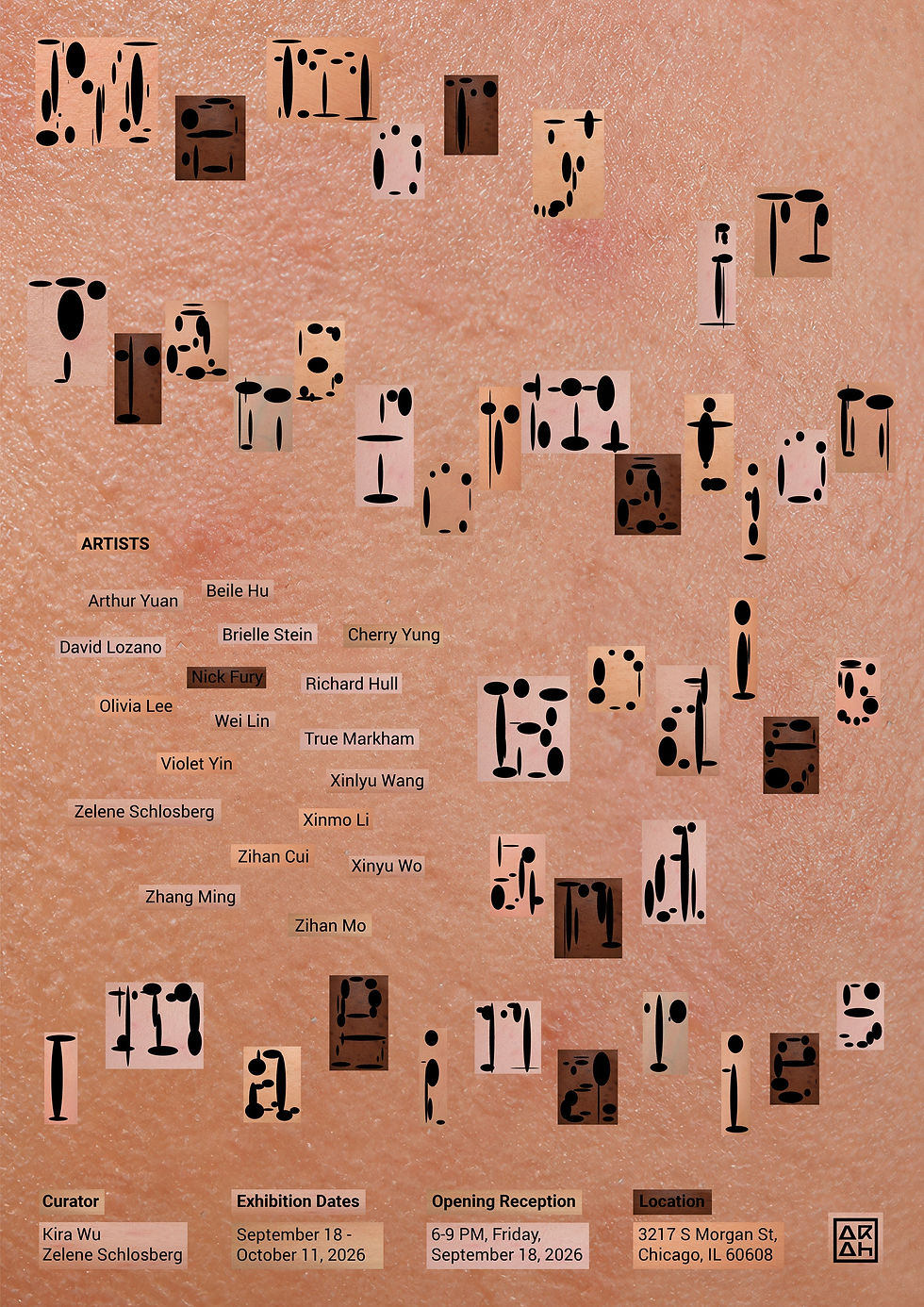


The poster series for Memory in Transformation — Bodies and Posthuman Imaginaries was designed by Dr. Junfeng Zhang. Taking skin as its point of departure, the design responds to the exhibition’s discussions of the body, memory, and the posthuman. The three posters use different skin tones as backgrounds, with letters and artists’ names set within sections of skin to create a visual language between bodily traces and informational symbols. Variations on the circle form a series of experimental letterforms. Stretched, clustered, and displaced, the letters hover on the threshold of recognition, responding to the continual transformation of memory through the body and technology.
Qigu Jiang, founder and academic director of the Research House for Asian Art (RHAA), artist, and professor in the Departments of Painting and Drawing and Art History, Theory, and Criticism at the School of the Art Institute of Chicago, offers the following introduction: The Research House for Asian Art (RHAA) is a non-profit art organization founded in 2008 in Chicago. RHAA aims to promote awareness of Asian culture and foster ongoing exchanges of culture and art between East and West. RHAA is dedicated to the creation, presentation, and development of Asian contemporary art. RHAA opened its gallery in May 2012 and presents a diverse array of exhibitions showcasing the latest in contemporary art from Asia by emerging Asian artists, alongside contemporary artworks by local artists. Since its opening in 2012, RHAA has mounted more than 30 exhibitions that have enriched the cultural life of the city community. RHAA also organizes symposia addressing issues of contemporary art theory and criticism. Besides contemporary art, RHAA undertakes and supports research projects on ancient Far Eastern Asian art.


Comments